The Game Was a Disguise

Most briefs ask you to make something visible.
This one asked me to make sure someone couldn’t be seen.
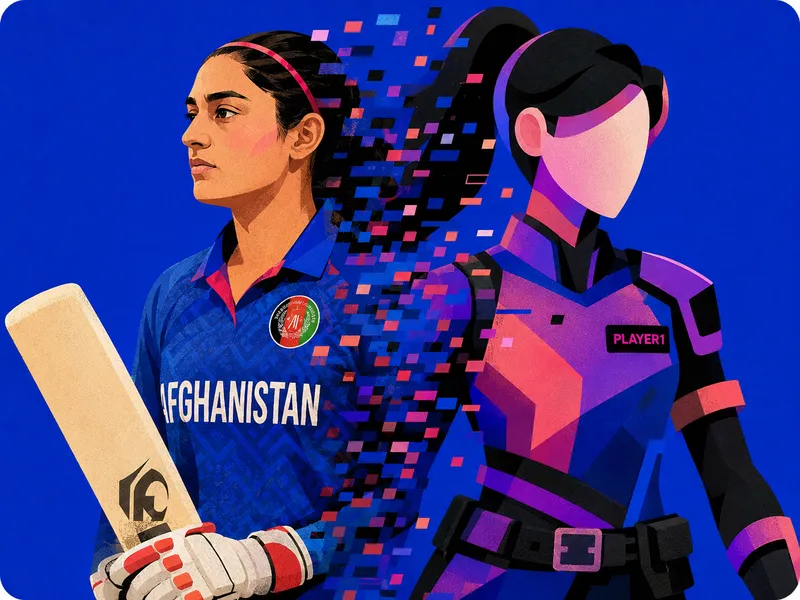
In 2022 I was art director on a campaign called Protest Match. The subject wasn’t a product or a logo. It was a team of women whose careers had been erased, and who were, some of them, still in danger as we worked.
The idea in 20 seconds
- In November 2020, Afghanistan named its first-ever women’s national cricket team. Twenty-five players. Real contracts.
- About nine months later, the Taliban took Kabul and banned women from sport. Those careers vanished overnight. The players fled.
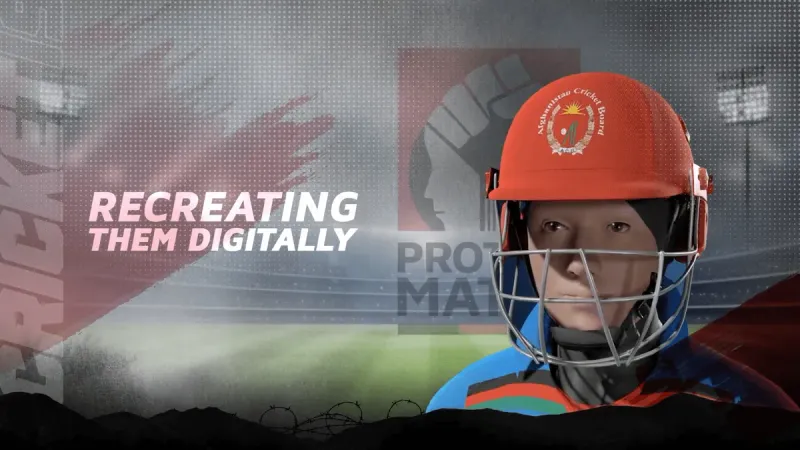
- We rebuilt the banned team as avatars inside Cricket 19, a popular cricket video game, and livestreamed a match against Australia on Steam as a protest. No ticket gates. No broadcast rights. Just a link.
- The avatars let players be on the pitch without being on camera.
- The game wasn’t only the stage. For the ones still in danger, it was a disguise.
What do you do when the story could get someone hurt?
The instinct in advertising is to show the real person. Their face. Their voice. That’s what makes a story land.
Here, that instinct was the risk.
So the first question wasn’t creative. It was: who is safe to show, and who isn’t?
That question changed everything about how the work was built. This was made with Global Esports, the game Cricket 19, and the agency Dentsu, and the agency had a team handling outreach and consent. Two of the players we spoke to were already public spokespeople, reached through Twitter. Even so, consent had to be the frame around the whole thing, not a checkbox at the end.
Not everyone could come forward
We reached eight players.
Only four came fully forward.
Two took part but would not show their face or their voice.
Two couldn’t take part at all. They were fighting for their families’ safety. As it was put to me, they “didn’t have the luxury to be interested.”
I’ve thought about that line a lot. In our world a campaign is the priority. In theirs, it was noise against the sound of trying to stay alive.
You don’t argue with that. You design around it.
How does the medium become the shield?
Because we rebuilt the team as avatars, a player could stand on the pitch without standing in front of a camera.
For the two who couldn’t show their face or voice, that wasn’t a limitation. It was the whole point. The game gave them a body that wasn’t theirs. A presence with no biometric trace. They could be counted, seen, cheered for, and still be untraceable.
The medium didn’t just dodge the censors and the ticket gates and the broadcast rights. It protected the people inside it.
That reframed the job for me. I’d assumed the game was the clever stage for a story. It was actually the safest container we could put a person in. Sometimes the most respectful way to show someone is to not show them at all, and to make that absence part of the design instead of an apology for it.
So did it work?
That depends what you count.
For one night, on a Steam livestream, a team that had been banned from existing got to play. People watched. That was real.
But I won’t pretend it into a win.
Roya Samim, one of the players, got out. She fled to Canada with her two sisters and now plays club cricket in Fredericton, New Brunswick, keeping, in her words, a candle lit for the women’s game.
The team itself never came back. The Afghanistan women’s team never played a single official match. Their first, against Oman, was cancelled, and it was never restored. Roya has spoken about being let down by the ICC.
So this is the honest shape of it. We gave them a pitch for one night, inside a game. The real team never returned. The players scattered across the world and rebuilt their lives, one at a time, alone.
Design protected the people who trusted us with their faces. That part I’d stand behind again.
It just couldn’t give them back the thing that was taken.
Sources and further reading
More writing
 human factorssystems design
We Made Them Better Traders. They Still Lost.
I designed a crypto app that made trading simple, fun, and better. People still lost money, because the real game was never about skill.
 systems designerror preventionhuman factors
The $125 Million Unit Label
The Mars Climate Orbiter was lost at the boundary between two teams, and that boundary is where many systems actually fail.
 human factorserror preventionsystems design
The Word "Takeoff" Had Two Meanings
The Tenerife airport disaster shows why critical systems cannot rely on language that merely sounds understood.